Savebot: The Last Garden
Program one robot. Bring a world back.
Build your first Collector around three decisions. Recharge on low battery, recycle when full, and collect in the remaining case. Pick the instructions for your editor and use live readings when a robot surprises you.
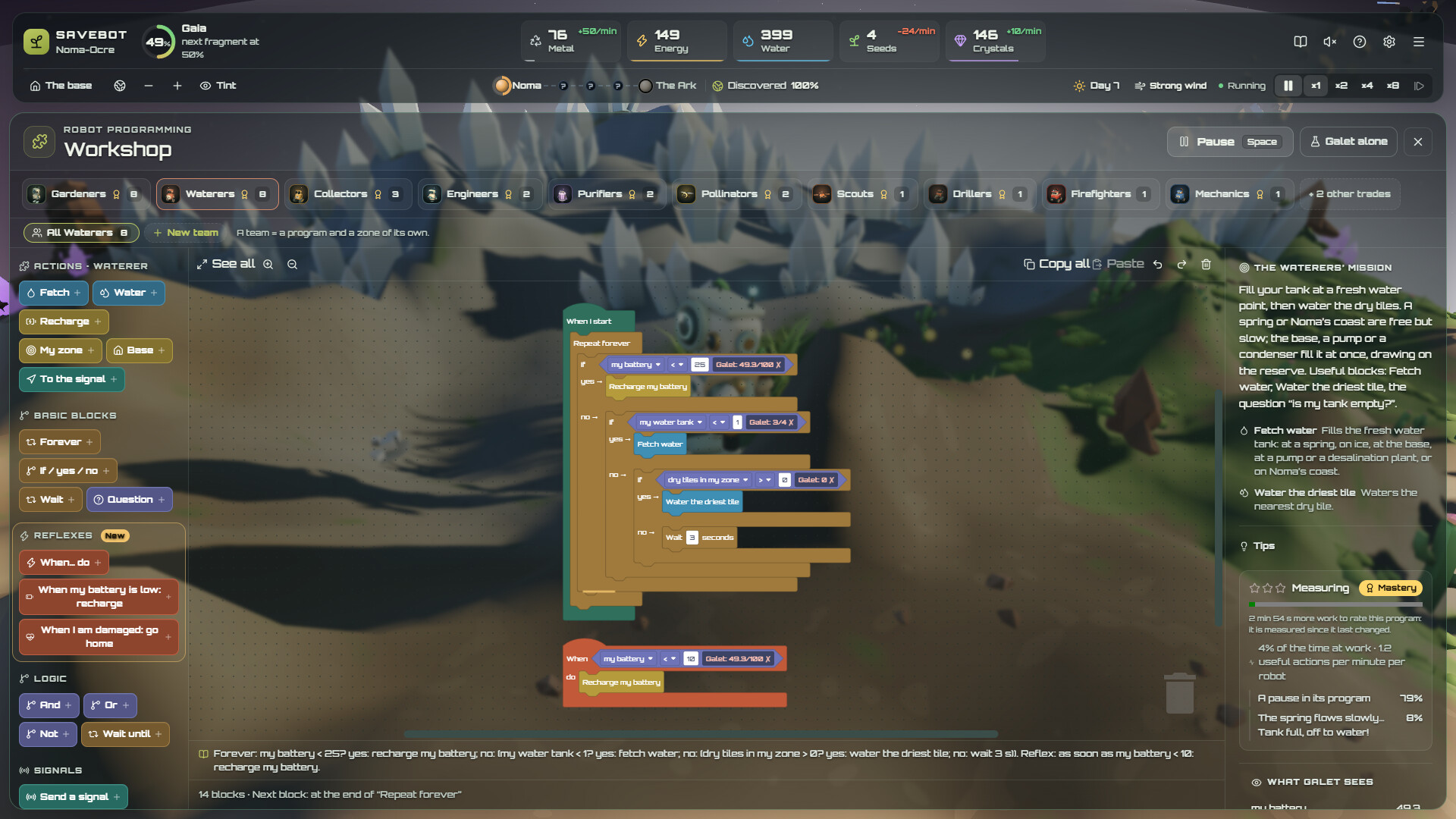
Savebot: The Last Garden is a robot programming and ecological simulation game by Leslie Forgeur of Forgeur Games. It launched on Steam for Windows on November 16, 2026. See the official Steam listing.
Watch the robots at work
Find a guide
Getting Started & Modes
Choose a programming mode, teach Bip its first job and learn how to read a changing world.
Programming & Debugging
Build a Collector in blocks or code, inspect live sensor values and find the block that took the wrong branch.
- Build your first Collector in Balanced
- Write your first Collector loop in Harsh
- Fix a red line in Harsh code
- Use a breakpoint to stop at the problem block
- Read the selected robot’s live sensor values
- Check a block program using its sentence
- Collector skips recycling or keeps collecting
- Robot runs out of battery
Thalassa
Read the tides, collect flotsam safely and send plants or coral toward new locations.
Twilight
Move heat through relays and teach your robots to shelter from solar flares.
Sylve
Clear grey fungus, extend the root network and teach other robots how to answer a help call.
Pick your first job by what you can see
Start with one robot and an outcome you can recognize without opening several screens. On Noma, a collection and recycling job is a useful first test. You can see the robot pick up material, check whether it continues as cargo changes and watch the deposit. The first success is a complete cycle with a recognizable result. A robot that starts traveling but never completes a deposit still has a job to diagnose.
Choose the guide that matches your editor. Peaceful supplies useful tests. Balanced asks you to build the tests with blocks. Harsh uses the game's own Python-like language. In all three modes, identify the same pieces of the job: a signal from the world, the decision it should select and the observable end of that action. For the Collector, the official Harsh sample tests low battery before checking full cargo. If both are true, watch for recharge first.
Find the right guide for a robot that stopped making progress
If the robot takes an unexpected action, select that robot in the Workshop. Check whether the intended action ever runs. In the block editor, the sentence under the program helps you inspect which test owns the action. The live value beside a condition helps when that layout makes sense but the decision still surprises you. A breakpoint is useful when a later action hides the first wrong decision.
If the editor marks a line in Harsh, read the actual name and suggestion shown by the game. Fix that one problem before judging how the robot behaves in the world. If the program runs and the robot arrives somewhere without producing the expected result, investigate the target and current world state. A correct command can still be used at a poor time or on the wrong area.
Treat each world as its own problem
On Noma, use a small patch to see how pioneers prepare soil before introducing flowers or trees. For an active threat, read its cause, countdown and remedy before assigning a response. On Thalassa, the foreshore changes with the tide. The timing that makes flotsam collectible does not make the same location suitable for a building. Wind-sown seeds and waterborne larvae also use different actions.
On Twilight, check both ends of any heat handoff before you assign more robots to it. When a solar flare interrupts ordinary work, confirm that the robot actually reaches the sail's shade or mild ground. On Sylve, decide whether you need fertile soil in one spot, a root network that encloses a grey patch or a second robot that answers a call. The sender and the helper solve different parts of that last task.
Know when a one-time success is ready to scale up
Check the next transition after a job first works. A Recycler that handles one load should be able to return to its next useful action. A sheltered robot should still have a way back to its work when the relevant condition allows it. An Ark pantry that looks full on arrival should also replace what its own robots consume. Pause before copying a routine to another robot or world if you cannot point to the condition that starts it, the outcome it produces and how it gets ready for the next cycle.